Shots:
- Precision, convenience, and disease modification define 2025 drug approvals as regulators reward biologically clear, patient-specific therapies that fragment legacy markets, elevate rare diseases, and prioritize meaningful outcomes over broad labels.
- Innovation is shifting from complexity to usability with oral, subcutaneous, topical, and on-demand therapies improving access and adherence across neurology, cardiology, endocrinology, ophthalmology, and dermatology.
- The industry is moving from chronic management to biological interception where early, mechanism-driven intervention in nephrology, pulmonology, metabolic, infectious, and rare diseases is redefining long-term clinical and commercial value.
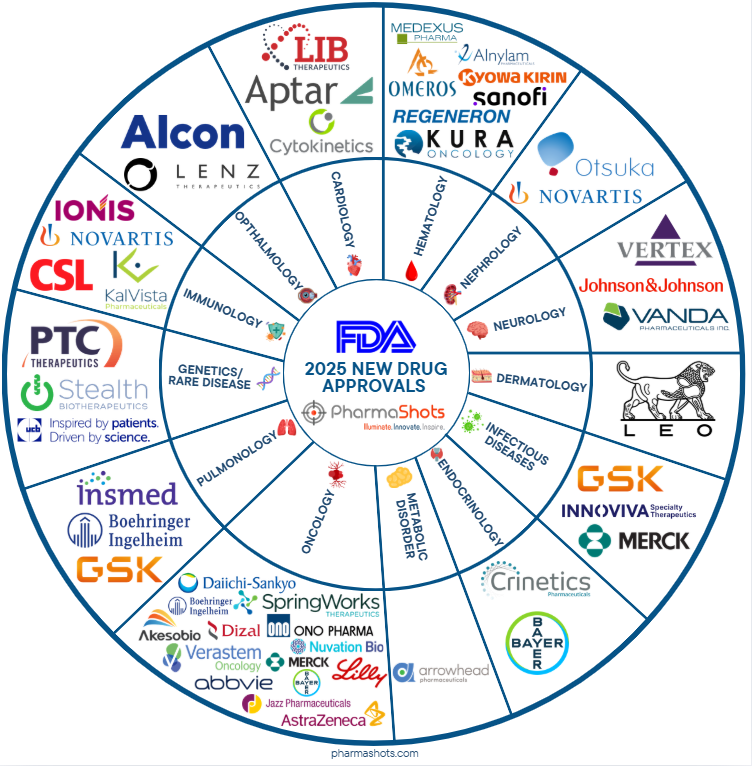
2025 is emerging as a pivotal year in drug approvals not because of volume, but because of intent. Across therapy areas, regulators are consistently rewarding medicines that demonstrate biological clarity, patient specificity, and meaningful outcomes. Broad labels are giving way to targeted interventions. Convenience is becoming innovation. And diseases once considered marginal are finally commanding center stage.
Below is a therapy-area–wise snapshot of how 2025 is reshaping the pharmaceutical landscape.
Oncology: Precision, Payloads, and the End of One-Size-Fits-All
Oncology approvals in 2025 reinforce a clear direction: precision is the price of entry.
Next-generation antibody drug conjugates are redefining competitive strategy. Datroway (datopotamab deruxtecan) strengthens the ADC footprint in HR+/HER2– breast cancer, while Emrelis (telisotuzumab vedotin) validates protein overexpression—such as c-Met—as a commercially viable biomarker in NSCLC.
Small molecules are equally resurgent. From KRAS-mutant ovarian cancer to increasingly fragmented NSCLC subtypes, mutation-specific therapies like avutometinib combinations, sunvozertinib, taletrectinib, and zongertinib are carving oncology into narrower, defensible segments.
Immuno-oncology is evolving operationally as well. Subcutaneous pembrolizumab expands access and reinforces lifecycle leadership, while regionally focused innovations like penpulimab signal China’s growing role in global oncology.
Ultra-rare and historically untouchable tumors are no longer overlooked. Approvals in diffuse midline glioma and ESR1-mutant breast cancer underscore a willingness to tackle biology others avoided.
Oncology in 2025 is no longer about being first it’s about being precise, provable, and unavoidable.
Neurology: From Symptom Control to Functional Precision
Neurology approvals this year emphasize function, usability, and quality of life.
Non-opioid pain management takes a major step forward with suzetrigine, offering an oral alternative aligned with opioid-sparing healthcare priorities. Autoimmune neurology continues its biologic expansion with FcRn inhibition in myasthenia gravis, while motion-related vomiting gains targeted pharmacologic attention.
These approvals reflect a broader reset: neurology is moving away from blunt symptom suppression toward mechanism-aware, patient-centric interventions.
Cardiology: Precision Control in a Legacy Market
Cardiology’s 2025 approvals reflect refinement rather than disruption.
Protein-engineered LDL therapies are expanding options for patients inadequately controlled by statins and PCSK9 inhibitors. Episodic arrhythmia management enters a new phase with on-demand therapies designed to reduce emergency dependence. Meanwhile, hypertrophic cardiomyopathy continues its shift from surgical intervention to pharmacologic precision via cardiac myosin inhibition.
Cardiology is becoming more situational, personalized, and patient-empowered—without abandoning its scale.
Endocrinology: From Replacement to Regulation
Endocrinology in 2025 is moving beyond hormone replacement toward signal-level control.
Oral therapies are reshaping acromegaly management, reducing injection dependence and improving adherence. Menopause care enters a new era with non-hormonal treatments for vasomotor symptoms, broadening access for women contraindicated for estrogen therapy.
The focus is clear: precision, convenience, and long-term balance.
Hereditary & Rare Diseases: Precision Where It Matters Most
Rare disease innovation in 2025 prioritizes impact per patient.
Genotype-responsive therapies in PKU, mitochondrial-targeted peptides in Barth syndrome, and early-intervention strategies in pediatric genetic disorders highlight a shift toward biologically exact solutions. These approvals reinforce the importance of early diagnosis, genetic screening, and functional endpoints over population averages.
Rare is no longer peripheral it is proving ground for the future of medicine.
Hematology: Persistence Meets Precision
Hematology approvals this year focus on late-line, high-complexity disease.
RNA therapies are redefining hemophilia management. Targeted treatments are fragmenting AML by mutation status. Immunotherapy continues to push boundaries in refractory myeloma, while complement inhibition addresses life-threatening transplant complications.
Hematology in 2025 is about staying in the fight until biology yields.
Immunology: Architected Immune Control
Immunology approvals reflect a shift from reaction to anticipation.
Hereditary angioedema emerges as a blueprint disease, with prevention, rescue, and maintenance therapies spanning antibodies, antisense oligonucleotides, and oral small molecules. Chronic inflammatory conditions are seeing renewed interest in oral precision therapies that rival biologics in selectivity.
Immune modulation is becoming predictable, modular, and patient-driven.
Infectious Diseases: Precision in a Post-Resistance Era
With resistance accelerating, infectious disease approvals emphasize novel mechanisms and prevention.
New oral antibiotics for UTIs and gonorrhea demonstrate that antibacterial innovation is still possible when mechanisms are genuinely differentiated. Passive immunization for RSV highlights prevention as a central strategy, particularly in pediatrics.
The focus is shifting from cure alone to containment, durability, and preparedness.
Metabolic Disorders: Correcting Extreme Biology
Metabolic innovation in 2025 targets genetic extremes, not lifestyle modulation.
RNA-based triglyceride lowering for familial chylomicronemia syndrome exemplifies upstream intervention, addressing disease at its molecular source rather than managing downstream complications.
This is metabolism reimagined decisive, infrequent, and genetically precise.
Nephrology: From Decline Management to Disease Modification
Nephrology approvals signal long-awaited progress.
Targeted oral therapies and immune-focused biologics are converging in IgA nephropathy, with proteinuria reduction emerging as a meaningful regulatory endpoint. The emphasis is shifting toward earlier intervention and preservation of kidney function.
Nephrology is moving from inevitability to interception.
Ophthalmology: Vision Care Without the Needle
Ophthalmology continues its pivot toward non-invasive, everyday therapies.
Topical small molecules are raising expectations in dry eye disease, while presbyopia enters the pharmaceutical era with non-surgical correction options. Quality of life and convenience are now central to clinical value.
Vision care is becoming simpler, safer, and more accessible.
Pulmonology: From Relief to Interception
Pulmonology approvals in 2025 reflect deeper biological engagement.
Bronchiectasis finally gains a disease-modifying therapy. Fibrotic lung disease sees continued innovation beyond symptom slowing. Severe asthma is increasingly segmented by phenotype and biomarkers.
Respiratory care is evolving from rescue to long-term disease control.
Dermatology: Precision Topicals for Chronic Control
Dermatology in 2025 embraces chronic disease thinking.
Advanced topical therapies now offer targeted anti-inflammatory control without systemic exposure, particularly in steroid-limited conditions like chronic hand eczema. Long-term management, durability, and functional outcomes are reshaping standards of care.
Skin disease is being treated with the same seriousness as systemic inflammation.
The Big Picture: What 2025 Reveals
Across therapy areas, the message is consistent:
- Precision is non-negotiable
- Convenience is innovation
- Rare and severe diseases are no longer sidelined
- Biology, not breadth, defines value
2025 is not a year of incremental progress it’s a year of intentional medicine.
Related Post: A Complete Account of FDA Approvals in 2024